| Availability: | |
|---|---|
| Quantity: | |
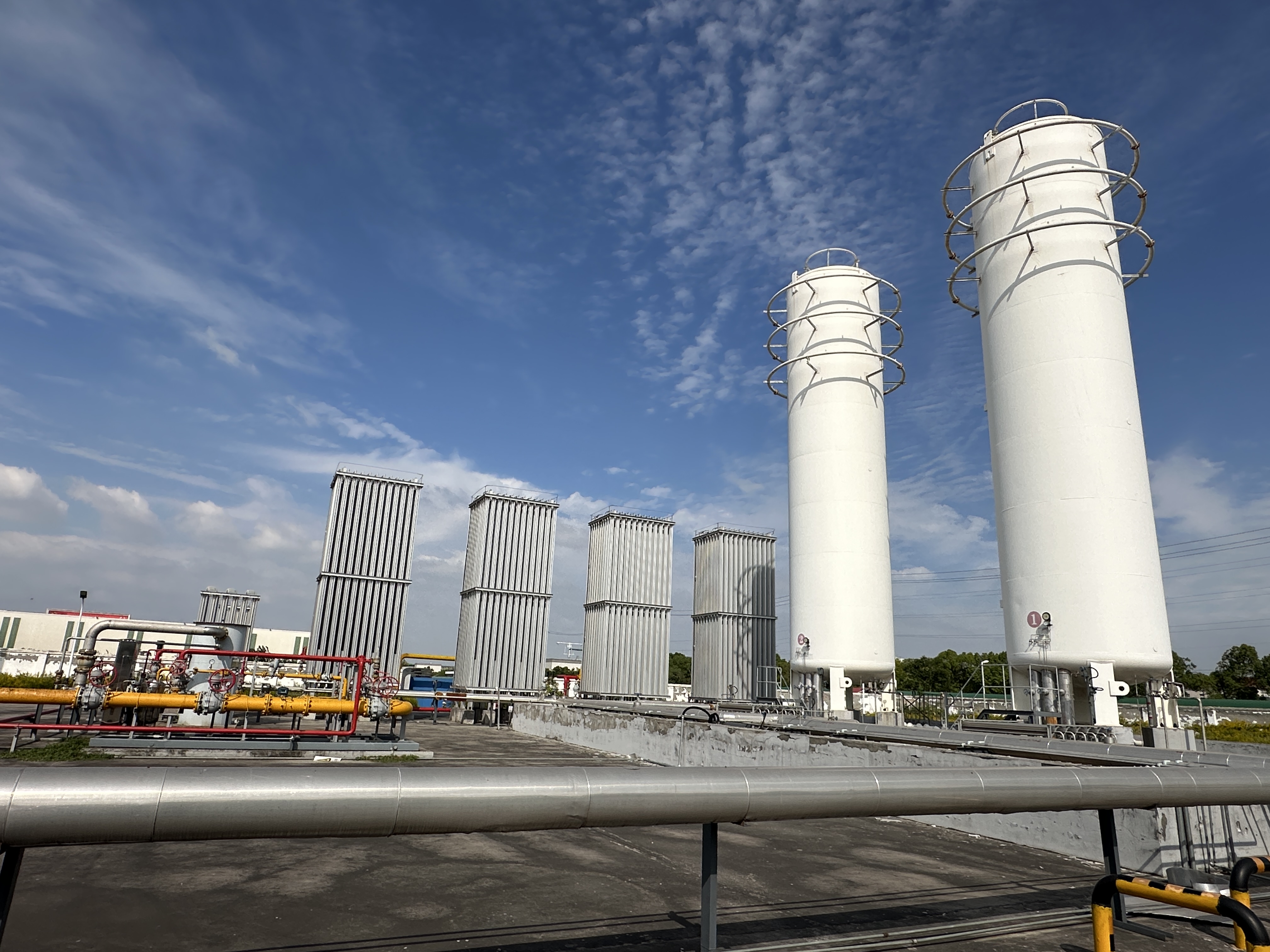
As a core equipment for LNG utilization, the LNG Regasification Standard Station integrates LNG storage, pressure boosting, regasification, and gas supply functions, tailored for industrial, commercial, and municipal natural gas demand scenarios. It features a modular skid-mounted design, which significantly shortens on-site installation time and reduces construction costs.
Core Components & Functions:
LNG Storage Tank Skid: Serves as the core for LNG storage and fluid supply, available for purchase or provided directly by users based on specific demand.
Unloading PBU Skid: Ensures stable pressure boosting and pressure maintenance during LNG tanker unloading. It creates a normal pressure difference between the tanker and the storage tank, enabling efficient and safe LNG filling.
Regasification System: Optimizes gas supply stability. When the gas flow rate reaches or exceeds 1000Nm³/h, we recommend installing the LNG vaporizer as a separate skid or on an on-site foundation to avoid operational bottlenecks.
This station is widely used in scenarios such as industrial boiler gas supply, commercial central heating, and small-scale municipal gas networks, providing a reliable and efficient LNG-to-gas solution.
LNG regasification standard station
a) LNG storage tank skid: for LNG storage and the fluid supply, generally purchased or provided directly by the user.
b) Unloading PBU skid: for boosting and the constant pressure when the LNG tanker unloading fluid, then the LNG storage tanks can reach the normal fluid pressure difference, so the LNG tankers can irrigation charging.
c) When the flow rate≥1000Nm³/h, it is recommended LNG vaporizer prized separately or foundational separately on-site.

LNG Storage Tank: Popular sizes range from 20m³ to 200m³, with a built-in PBU (Pressure Building Unit) system for autonomous pressure regulation.
Vaporizer: 2 sets (optional), with a gasification capacity of 100~3000Nm³/H, ensuring continuous gas supply even during peak demand.
Reheater: Optional heating methods include electric heating and steam heating, adaptable to different on-site energy conditions.
Odorization Device: Optional self-priming pump or metering pump, complying with local gas safety standards by adding odorants for leak detection.
Metering System: Optional turbine flowmeter or Roots flowmeter, ensuring accurate gas consumption measurement for billing and management.
Safety & Monitoring: Optional remote monitoring system and emergency cut-off device, enabling real-time data tracking and rapid response to abnormal conditions.
Guide for LNG Solution Model Selection
Gas consumption | Product Name | Max. Gas Supply |
Below 200 | Cylinders | N·7 / N·11 |
100~2,000 | Gas Cylinder Group Skid Station | 200 Typical models: |
Around 1,000 | Micro Bulk Station | 200 |
500~10,000 | Modular Gasification Station | 2,000 |
FOR NGV | LNG REFILLING STATTION |
Remark: LNG modular regas station can be customized based on per clients’ request.
SinoCleansky LNG modular regas station are manufactured under strictly quality control system. The LNG modular regas station are with inspection report submitted to clients. With client’s requirements, SinoCleansky will also provide some other certificates as per clients’ request. We assure you that all LNG modular regas station are 100% traceable.
Complies with the ASME Boiler and Pressure Vessel Code Rules, Section VIII, Division 1, a globally recognized standard for pressure equipment.
Provides a complete set of inspection reports to clients, including pressure test reports, non-destructive testing (NDT) reports, cold stretch test reports, and helium leak detection reports.
On request, additional certificates (such as material certification, welder qualification certificates) can be provided to meet local regulatory requirements.
Warranty & Traceability: All stations are 100% traceable, covering key components like storage tanks, valves, and vaporizers. We offer technical support and after-sales service throughout the product lifecycle to address operational issues promptly.
Reference certifications and reports:


The LNG modular regas station can be shipped by different types of containers, bulk vessel and etc.;
Packaging: Skid-mounted units are fixed with anti-collision buffers and moisture-proof materials to prevent damage during transportation. Valves, gauges, and other precision components are packed in separate waterproof boxes for extra protection.
Shipping Methods:
Container Shipping: Suitable for standard skid units, using 20GP, 40GP, or 40HQ containers based on skid size.
Bulk Vessel Shipping: For large-scale or customized skids, bulk vessels are used to accommodate oversized components.
On-site Coordination: Our logistics team coordinates with clients to confirm delivery schedules, customs clearance documents, and on-site unloading plans, ensuring a smooth supply chain.
What are LNG exports and why are they reshaping global energy markets? Simply put, LNG exports involve turning natural gas into a liquid form so it can travel long distances safely and efficiently. Learn how U.S. LNG exports work, their economic benefits, emerging markets, and innovative technologies driving growth in the global energy sector.
What is LNG used for? Liquefied Natural Gas (LNG) is more than just a fuel—it powers homes, businesses, industries, and even transportation. Its high energy density, cleaner combustion, and flexible transport make LNG ideal for residential heating, industrial processes, and off-grid applications. Learn what LNG is used for across sectors from heating and cooking to transport and manufacturing. Discover its role in cleaner energy, cost savings, and reliable global supply.
What is LNG? Simply put, LNG, or liquefied natural gas, is natural gas cooled into a liquid for easier storage and transport. It’s a versatile, low-carbon energy source powering homes, industries, and transportation worldwide. Learn all about LNG—liquefied natural gas—its storage, transport benefits, and role in cleaner energy. Explore innovations, environmental advantages, and global market trends.
How LNG is produced is a fascinating journey from natural gas extraction to advanced liquefaction technologies. Learn how LNG is produced efficiently and safely. Explore liquefaction techniques, modular systems, cold energy recovery, and environmental responsibility in today’s LNG industry.
What is LNG and how is it transported is becoming a key question for industries seeking cleaner, efficient energy. LNG, or liquefied natural gas, allows natural gas to travel long distances in liquid form, using ships, trucks, rail, and containers. Learn everything about LNG, its liquefaction, transportation across oceans and roads, storage solutions, and regasification for homes and industries.
A CNG skid serves as a critical solution for the safe storage and transport of compressed natural gas. This equipment supports industries that need efficient energy sources for vehicles, heating, and manufacturing. The market for these systems continues to expand rapidly:The global CNG Tube Skids ma
When dealing with large volumes of liquids and gases, choosing the right storage and transport solution is crucial. One of the most common options is the ISO tank, which is designed for safe and efficient transport. However, there’s another essential option: the storage tank. In this article, we will explore the key differences between ISO tanks and storage tanks. You’ll gain insights into their designs, functionalities, and how to choose the right one for your specific needs.
In this article, we will explore the importance of ISO standards in LNG production. You will learn how ISO certification helps enhance efficiency, safety, and sustainability across the LNG supply chain.
In this article, we will explore what LNG storage tanks are, why they are essential, and how they keep LNG in its liquid form. You’ll also learn about the different types of storage tanks and the safety features that make them reliable for large-scale operations.
IntroductionCNG cylinders are transforming the way we fuel vehicles and industries. As the world seeks cleaner energy alternatives, these cylinders play a key role in storing and transporting compressed natural gas (CNG).In this article, we will explore what CNG cylinders are, their various types, how they work, and their many benefits. You’ll also learn how these cylinders are crucial in the shift toward sustainable energy solutions.
IntroductionHave you ever wondered how compressed natural gas (CNG) powers vehicles and industries while reducing emissions? As the world shifts toward greener energy, CNG has emerged as a cleaner and more sustainable alternative to gasoline and diesel.In this article, we will explore how CNG cylinders work, their design, and safety features. You’ll also learn about the environmental and economic benefits of CNG and how it’s transforming industries.
Lorry Tanker - Application in MexicoLorry Tanker - Application of Low Temperature Tankers in JordanLorry tanker - Application of low-temperature tanker transportation in Vietnam
ISO Tank - Application of Aluminum Alloy Tank Container Transportation in AlbaniaISO Tank - Peruvian LNG Substation for Storage and Transportation Applications
Lorry Tanker Transforming Cryogenic Gas Logistics in Jordan and Vietnam What distinguishes our solution is its integrated design: a high-performance cryogenic storage tank paired with a purpose-built operation compartment. This combination eliminates the need for separate transport and filling equip
Microbulk Tank is designed with skid-mounted and vaporizer built-in, high quality, efficient, reliable, lower charge loss and longer liquid gas hold time…… Microbulk Tank layout will help you to be the “Hero” in wide applications including industrial , medical, welding, laser cutting, lab, etc. It’s
Industrial gas and LNG companies across nations have unlocked new efficiency with our ISO Tank. Its standard container design integrates into diverse transport systems—road, rail, sea—adapting to global logistics needs. For cryogenic gas transport, it’s the best transport container. Inside the opera
Email:
Telephone:
Mobile & WhatsApp:
Address: