

Views: 0 Author: Site Editor Publish Time: 2026-10-12 Origin: Site


Transporting high-pressure Compressed Natural Gas (CNG) at scale demands strict structural integrity. Failure to meet international standards introduces severe safety and financial risks. Procurement and engineering teams navigate complex regulatory frameworks to source high-capacity storage solutions for virtual pipeline networks and mobile refueling stations. Buyers often struggle to differentiate between general-purpose gas tubes and specialized equipment engineered for the aggressive pressure cycling of CNG service.
This guide breaks down the technical specifications, compliance requirements, and evaluation criteria for sourcing an ISO 11120 CNG Container. It provides a framework to assess safety, payload efficiency, and operational reliability. You will learn how to evaluate metallurgical properties, understand pressure dynamics, and verify manufacturing certifications. This knowledge ensures your infrastructure investments remain safe, compliant, and highly productive.
Scope of Standard: ISO 11120:2015 governs the design, construction, and testing of refillable seamless steel tubes with water capacities between 150L and 3,000L.
Service Specificity is Critical: Not all ISO 11120 vessels are rated for CNG. Buyers must verify specific material compatibility and fatigue life calculations to prevent hydrogen embrittlement and stress corrosion cracking.
Operational Extremes: High-performance systems must be engineered not just for maximum working pressure, but for the extreme temperature drops (Joule-Thomson effect) and potential vacuum conditions encountered during rapid decanting.
Inspection & Maintenance: Long-term viability relies on strict adherence to periodic inspection protocols, including ultrasonic testing and neck mounting surface evaluations (e.g., CGA guidelines).
Payload vs. Weight: Evaluating CNG jumbo tube containers requires balancing maximum working pressure (typically 25MPa/250 bar) against the tare weight of the skid to optimize transportation logistics.
Table of Contents
ISO 11120:2015 specifies requirements for the materials, design, construction, manufacturing processes, and testing of refillable seamless steel tubes with water capacities exceeding 150 liters and up to 3,000 liters.
The ISO 11120:2015 standard for refillable seamless steel tubes applies to qualifying steel tubes used individually or in tube bundles, trailers, and multiple-element gas containers for compressed gas transportation and distribution.
For CNG applications, buyers should verify manufacturing documentation, material traceability, pressure ratings, testing records, and compatibility with the intended gas composition.
Compliance with ISO 11120 provides a technical basis for the pressure tubes themselves, but it does not automatically establish regulatory approval for the complete transport container or its supporting frame.
Not all high-pressure gas tubes are suitable for CNG applications. Frequent filling and discharge cycles create fatigue stresses, while moisture and corrosive impurities may affect cylinder durability. Tubes intended for CNG service must be approved for the specific gas composition and operating conditions.
Application |
Key Consideration |
|---|---|
General Industrial Gas |
Compatibility with the intended gas and pressure |
CNG Transportation |
Pressure cycling, fatigue resistance, and gas quality |
Hydrogen Blends |
Hydrogen compatibility and material embrittlement risks |
Important: Cylinders marked as unsuitable for CNG service must not be used for CNG transportation. Hydrogen service also requires a separate compatibility assessment.
CNG jumbo tubes commonly operate at working pressures of approximately 20–25 MPa (200–250 bar), depending on their approved design. Wall thickness is determined by cylinder dimensions, material strength, design pressure, and applicable standards.
Key technical parameters include:
Working Pressure: Approved operating pressure of the cylinder.
Wall Thickness: Calculated to withstand specified pressure loads.
Material Strength: Yield and tensile properties of the selected steel.
Temperature Conditions: Pressure variations caused by ambient temperature changes.
Design Verification: Required strength calculations and pressure testing.
Key Takeaway: ISO 11120 compliance provides a foundation for seamless steel tube quality, but CNG suitability must also be verified against the intended gas composition, pressure cycling, operating temperature, and applicable transport regulations.
Working Pressure (bar) |
Test Pressure (bar) |
Typical Wall Thickness (mm) |
Application Scenario |
|---|---|---|---|
200 |
300 |
14.5 - 16.0 |
Standard regional distribution |
250 |
375 |
17.5 - 19.0 |
High-capacity virtual pipelines |
300 |
450 |
21.0 - 23.5 |
Specialized heavy-duty transport |
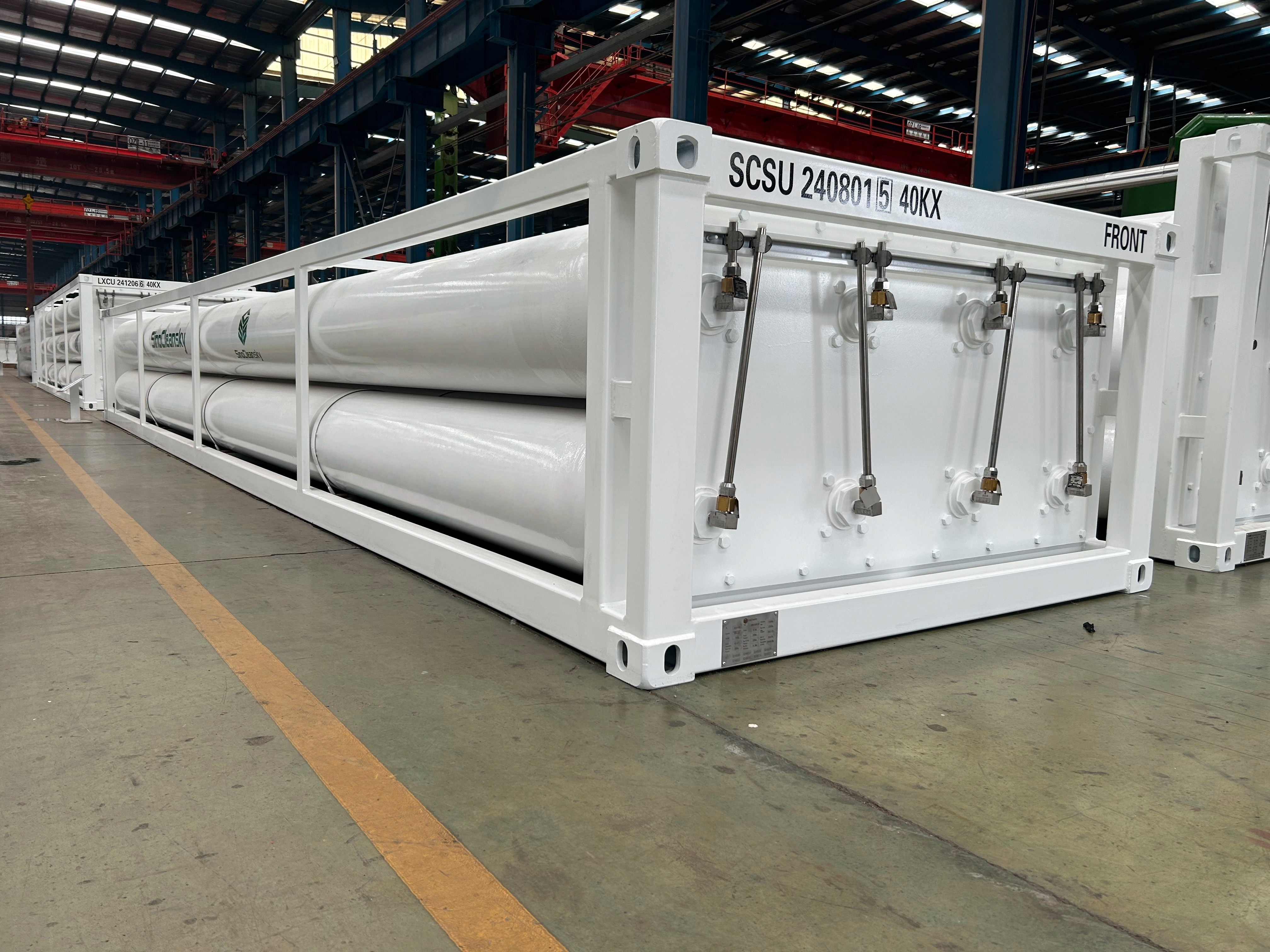
Manufacturers assemble these massive tubes into modular configurations. Common setups include 8-tube, 10-tube, or 12-tube bundle containers. These bundles are securely mounted inside standard 20ft or 40ft ISO frames. This modular approach creates CNG Jumbo Tube Containers. The frame provides structural protection during transit. It also standardizes the lifting and loading process for cranes and reach stackers.
Intermodal transport considerations heavily influence skid design. The 20ft and 40ft ISO frames feature standardized twist-lock integrations. This allows seamless transfer between ships, trains, and trucks. Structural rigidity is a primary engineering focus. The frame must prevent twisting or bending forces from transferring to the high-pressure tubes. Footprint optimization is necessary for virtual pipeline deployments. Operators need to maximize gas volume within strict dimensional limits.
Water capacity serves as the baseline measurement for cylinder volume. However, actual gas payload depends on thermodynamics. You must calculate payload using the specific gas compressibility factor. Temperature and pressure directly dictate how many standard cubic meters of gas fit inside. A 3,000L water capacity tube holds vastly different amounts of gas at 200 bar versus 250 bar.
Type 1 seamless tubes utilize specific grades of chromium-molybdenum (Cr-Mo) steel. This alloy provides an excellent balance of strength and toughness. Chromium enhances corrosion resistance and hardenability. Molybdenum increases high-temperature strength and prevents brittleness. The precise chemical composition is tightly controlled during the steelmaking process. This ensures consistent mechanical properties throughout the massive cylinder.
Engineers face trade-offs when selecting steel grades. Higher tensile strength allows for thinner walls. Thinner walls reduce the overall weight of the container. Lighter containers allow trucks to carry more payload without exceeding road weight limits. However, ultra-high-strength steels are more susceptible to sulfide stress cracking. This becomes a major issue in sour gas environments. Raw wellhead gas containing hydrogen sulfide requires lower yield strength materials to prevent sudden cracking.
Gas composition plays an important role in determining the suitability of seamless steel tubes for CNG transportation. Moisture, carbon dioxide, hydrogen sulfide, and other impurities can affect corrosion resistance and long-term cylinder reliability.
Hydrogen-containing gas mixtures may require additional material compatibility evaluation. The ISO 11114-4 standard provides testing methods for selecting steels resistant to hydrogen embrittlement in applicable gas cylinder applications.
Before selecting CNG jumbo tubes, buyers should obtain the intended gas composition, moisture specifications, operating pressure, and temperature conditions. For hydrogen blends or potentially embrittling gases, material compatibility must be verified against the applicable requirements rather than assuming standard CNG approval is sufficient.
Gas Source Type |
Typical Impurities |
Metallurgical Risk |
Required Mitigation |
|---|---|---|---|
Pipeline Quality (Treated) |
Trace moisture, minimal CO2 |
Low risk of internal corrosion |
Standard Cr-Mo steel, routine moisture checks |
Raw Wellhead Gas (Sweet) |
High moisture, heavy hydrocarbons |
General internal rusting, liquid pooling |
Upstream dehydration, increased corrosion allowance |
Raw Wellhead Gas (Sour) |
H2S, CO2, high moisture |
Sulfide Stress Cracking (SSC) |
Lower yield strength steel, strict H2S limits, internal coating |
Hydrogen Blends (H2/CNG) |
Hydrogen molecules |
Hydrogen Embrittlement |
Specialized alloys, complete metallurgical reassessment |
Payload optimization balances cylinder weight, gas storage capacity, and transportation efficiency. Type 1 steel cylinders offer durability and cost advantages, while composite cylinders reduce weight and may increase usable payload. The ideal configuration depends on vehicle weight limits, delivery frequency, operating pressure, and whether the skid is used for transportation or stationary storage.
Cylinder Type |
Main Advantage |
Key Consideration |
|---|---|---|
Type 1 Steel |
Durable and cost-effective |
Higher tare weight |
Type 2 Composite |
Reduced weight |
Additional inspection requirements |
Type 3 Composite |
Significant weight savings |
Higher initial cost |
Type 4 Composite |
Lightweight construction |
Material compatibility and operating limitations |
High-pressure valves and manifolds control gas filling, storage, isolation, and discharge in CNG jumbo tube systems. Component selection must account for operating pressure, temperature, gas compatibility, connection design, and expected flow rates.
For example, Swagelok's high-pressure relief valve product range illustrates the importance of verifying pressure settings, valve materials, connection types, and operating limits when selecting high-pressure components.
However, general industrial relief valves should not automatically be treated as approved pressure relief devices for CNG transport cylinders. Cylinder pressure relief devices and manifold protection systems must satisfy the applicable transport regulations, equipment specifications, and certification requirements.
Factory testing verifies cylinder strength, material quality, and manufacturing consistency before delivery. Required procedures depend on the applicable cylinder design and certification standard.
Test Method |
Purpose |
|---|---|
Hydrostatic Testing |
Verify pressure resistance and deformation |
Ultrasonic Testing |
Detect internal material defects |
Magnetic Particle Inspection |
Identify surface cracks in applicable steel components |
Material Test Reports (MTRs) |
Confirm material composition and traceability |
Periodic inspection and recertification help maintain long-term cylinder safety. Inspection intervals depend on cylinder specifications, transport regulations, and operating conditions. Common evaluation methods include visual examination, pressure testing, and approved non-destructive testing techniques.
Acoustic Emission (AE) testing may provide an alternative assessment method where permitted by the applicable regulations and approved inspection procedures.
Repeated filling and discharging expose high-pressure cylinders to cyclic stress, which can contribute to material fatigue over time. Operators should monitor pressure cycles, operating conditions, and inspection history to evaluate remaining service life.
Recommended practices include:
Record filling and discharge cycles.
Monitor operating pressure and temperature.
Conduct scheduled structural inspections.
Follow applicable cylinder service-life and retirement requirements.
High-pressure gas tube skids must meet the regulatory requirements of their destination markets. International standards such as ISO 11120 may apply alongside regional transportation and equipment regulations.
Market |
Key Regulatory Framework |
|---|---|
North America |
Applicable DOT and Transport Canada requirements |
Europe |
ADR requirements for road transportation |
International Maritime Transport |
IMDG Code |
International Cylinder Manufacturing |
ISO 11120, where applicable |
Buyers should verify required certifications, approvals, and markings before placing an order.
Manufacturer qualification is essential when purchasing CNG tube skids. Buyers should evaluate production experience, quality management systems, technical capabilities, and third-party inspection arrangements.
Key procurement checks include:
Material Compatibility: Verify gas composition, moisture limits, and cylinder material suitability.
Quality Documentation: Request MTRs, pressure test reports, and inspection certificates.
Design Verification: Confirm cylinder specifications, manifold pressure ratings, and expected operating temperatures.
Lifecycle Management: Review inspection procedures, pressure-cycle tracking, and maintenance support.
Key Takeaway: Selecting reliable CNG tube skids requires balancing payload capacity, pressure system safety, lifecycle inspection needs, and regional compliance. Proper manufacturer evaluation and complete quality documentation help reduce procurement risks and support long-term operation.
A: No. Standard industrial gas tubes are not engineered for the frequent and severe pressure cycling of CNG service. Using them for natural gas causes accelerated metal fatigue and risks structural failure. Always look for explicit CNG certification.
A: The lifespan depends on pressure cycles rather than chronological age. Most high-quality steel tubes are designed for 10,000 to 15,000 full pressure cycles. With proper maintenance and clean gas, they can operate safely for 15 to 20 years.
A: Regulatory bodies typically require periodic inspection and recertification every 5 to 10 years. The exact interval depends on your local jurisdiction and the corrosiveness of the transported gas.
A: AE testing is a non-destructive method used during periodic inspections. Sensors are attached to the pressurized tube to detect high-frequency sound waves generated by microscopic crack growth. This eliminates the need for water-based hydrostatic testing.
A: When high-pressure gas expands rapidly during decanting, it absorbs heat, causing extreme temperature drops. Valves and manifolds must be rated for these freezing conditions to prevent material embrittlement and seal failures.
A: No. Hydrogen molecules are small enough to permeate the steel matrix, causing severe hydrogen embrittlement. Transporting hydrogen requires entirely different metallurgical properties and specific vessel certifications.


