

Views: 0 Author: Site Editor Publish Time: 2026-10-12 Origin: Site


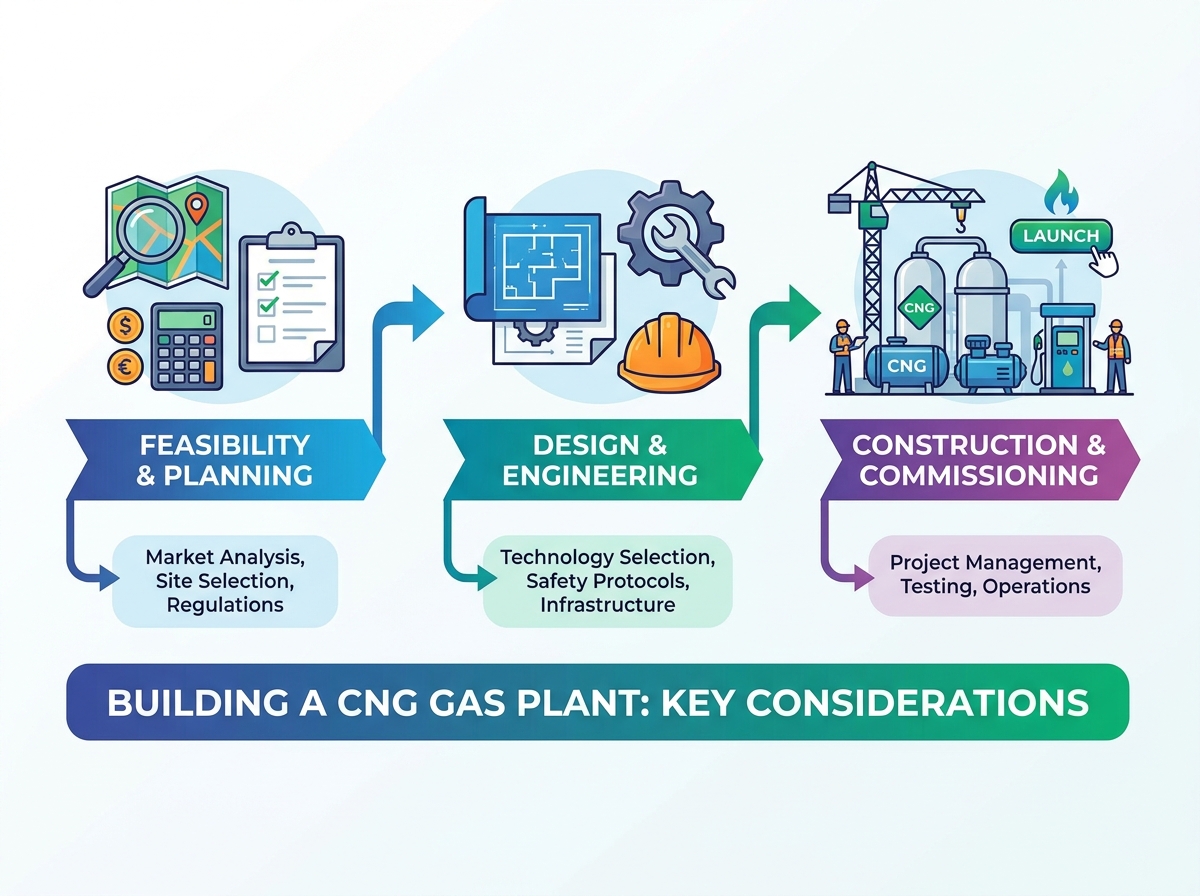
The transition to compressed natural gas offers significant fuel cost savings and emissions reductions for commercial fleets and municipalities. The infrastructure requires intensive upfront capital and precise engineering. Many developers and fleet operators underestimate the complexities of utility interconnections, gas inlet pressures, strategic site location, and long-term maintenance. This oversight leads to inflated operational costs and stranded assets. Successfully executing a project when Building a CNG Gas Plant requires a rigorous, evidence-based evaluation of site feasibility, equipment specifications, regulatory compliance, and financial modeling before breaking ground. You must align your system design strictly with your fleet’s dwell time and daily fuel consumption metrics. Utility constraints remain the primary bottleneck for most new developments. Proximity to high-pressure natural gas pipelines and adequate three-phase electrical power are non-negotiable prerequisites. You must secure these utilities early to prevent costly project delays.
Demand dictates design: The choice between fast-fill, time-fill, or combination systems must align strictly with your fleet’s dwell time and daily fuel consumption metrics.
Utility constraints are the primary bottleneck: Proximity to high-pressure natural gas pipelines and adequate three-phase electrical power are non-negotiable prerequisites for site selection.
CapEx vs. OpEx trade-offs: Under-sizing compressors reduces initial capital expenditure but exponentially increases energy consumption and maintenance costs over the lifecycle of the CNG gas plant.
Compliance is continuous: Adherence to stringent fire safety codes (e.g., NFPA 52), understanding the physical properties of CNG, and securing environmental permitting must be integrated into the earliest stages of project design to prevent costly retrofits.
Table of Contents
Establishing baseline operational requirements ensures the facility meets current demand without overcapitalizing on unnecessary capacity. Overbuilding wastes capital upfront and leaves equipment sitting idle. Underbuilding leads to vehicle queuing, driver overtime, and severe operational bottlenecks. You need a precise understanding of your daily throughput. Engineers must calculate the exact volume of gas required during peak fueling windows. This establishes the foundation for compressor sizing and storage capacity. You must define these parameters before selecting equipment vendors or signing land leases. Clear success criteria prevent scope creep during the construction phase. Every engineering decision must trace back to these initial operational requirements. If a component does not directly support the calculated throughput or safety mandates, you exclude it from the design.
Accurate demand forecasting dictates the entire facility design. You must calculate the daily gasoline gallon equivalents (GGE) required. Diesel gallon equivalents (DGE) provide the metric for heavy-duty fleets like refuse trucks or transit buses. You must evaluate vehicle dwell times accurately. Dwell time determines the necessary fill rate for your operation. A refuse fleet that parks for ten hours overnight has vastly different requirements than a regional haul fleet that runs slip-seat operations 24 hours a day.
Calculate total daily fuel consumption across the entire active fleet using historical diesel or gasoline burn rates.
Identify peak fueling windows to determine maximum hourly throughput requirements.
Measure average vehicle dwell time available for refueling operations without disrupting route schedules.
Project future fleet expansion over a five-year operational horizon to size underground conduit and concrete pads for future compressors.
Assess the specific onboard cylinder capacity and pressure ratings of your vehicles.
Analyze seasonal variations in fuel consumption, accounting for winter idling or summer air conditioning loads.
These calculations prevent undersized compressors. They also ensure you install adequate high-pressure storage. Accurate forecasting directly impacts your utility interconnection requests. You must present these exact flow rate figures to the local gas utility early in the planning phase.
CNG fueling station architecture should match fleet size, daily fuel demand, vehicle dwell time, and operating schedules. The main configurations include time-fill, fast-fill, and combination systems.
According to the U.S. Department of Energy's CNG fueling station guide, time-fill stations generally use compressors to refuel vehicles over extended parking periods, while fast-fill stations rely on appropriately sized compression and high-pressure storage systems for shorter fueling times.
Combination stations integrate both approaches to support mixed fleets. Selecting the right configuration helps balance compressor capacity, storage requirements, initial investment, and operational efficiency.
CNG station location directly affects fleet efficiency and operating costs. Sites near highways, logistics centers, and fleet depots help reduce unnecessary travel. Proper traffic planning, adequate turning space, and separate entry and exit routes support safe vehicle movement, minimize congestion, and improve fueling efficiency.
CNG station land requirements depend on compressor capacity, storage configuration, dispenser quantity, and vehicle circulation space. Commercial stations may require approximately 9,000–15,000 square feet or more, depending on the design. Local zoning regulations, safety setbacks, noise restrictions, and maintenance access must be considered during site planning.
Natural gas inlet pressure and electrical supply capacity are critical factors in CNG station feasibility. Higher pipeline pressure can reduce compressor energy consumption and equipment requirements, while low inlet pressure may require additional compression stages. Reliable three-phase electrical power and early utility coordination help prevent installation delays and unexpected infrastructure costs.
CNG compressor selection depends on the available natural gas inlet pressure, required discharge pressure, daily fueling demand, and peak operating conditions. Reciprocating compressors are commonly used for high-pressure natural gas fueling applications, while cooling arrangements help manage compression temperatures and protect internal components.
For example, Ariel's CNG compressors for vehicle fueling demonstrate how compressor configurations can be adapted to different inlet pressures, flow capacities, and fueling requirements.
When planning a station, engineers should evaluate compressor sizing, duty cycles, maintenance accessibility, energy consumption, and whether redundant compression capacity is necessary for uninterrupted operation.
CNG cascade storage systems typically use low-, medium-, and high-pressure banks to optimize vehicle filling and reduce compressor cycling. Priority valve panels control gas distribution between storage banks and dispensers. Properly rated pressure vessels, regular inspections, moisture management, and physical protection help ensure safe and reliable operation.

CNG dispensers require accurate flow measurement and reliable pressure control to support safe and efficient vehicle refueling. Coriolis mass flow meters are commonly used because they measure fuel mass directly and can support commercial fuel transactions.
For example, Emerson's Micro Motion CNG Coriolis Flow Meter is designed for compressed natural gas dispensing applications, including light-duty and heavy-duty vehicle fueling.
Engineers should also evaluate temperature compensation, emergency shutdown functions, hose breakaway protection, dispenser compatibility, and applicable metering certification requirements.
A detailed line-item breakdown is necessary for accurate financial modeling. You must account for engineering, permitting, and extensive site preparation. Geotechnical surveys and reinforced concrete pads for heavy equipment add significant upfront costs. Utility upgrades often represent a massive portion of the initial budget, especially if you must trench new high-pressure gas lines across public streets. Compressor skids, storage cascades, and dispensers require heavy capital investment. Point-of-sale systems, secure networking infrastructure, and canopy construction add to the total cost. You must factor in regional government grants and tax incentives. Carbon credits can significantly offset your initial construction costs depending on your jurisdiction. Engaging a grant writer early can improve your project's financial viability by identifying state or federal infrastructure funding.
Calculating the electrical cost per gallon equivalent is a primary operational metric. Electricity remains the largest ongoing expense in a CNG Gas Plant. You must implement energy efficiency proposals to control these costs. Installing variable frequency drives (VFDs) on compressors reduces massive startup power surges. Power factor correction equipment stabilizes your electrical draw from the grid, preventing utility penalties. Optimizing storage cascade sequencing reduces peak electrical demand charges. If your compressor kicks on during peak afternoon hours, the utility may charge a premium rate for the entire billing cycle. You must monitor your utility bills for these peak demand penalties. Efficient operational software can schedule compressor runs during off-peak electrical hours, filling the storage cascades at night when power rates drop.
Cost Category |
Primary Components |
Optimization Strategy |
|---|---|---|
CapEx (Initial) |
Compressors, storage cascades, dispensers, site prep, utility trenching |
Leverage government grants, carbon credits, and select sites with existing high-pressure gas lines. |
OpEx (Ongoing) |
Electricity, utility demand charges, network fees |
Install VFDs, optimize storage cascade sequencing, and run compressors during off-peak hours. |
Maintenance |
Coalescing filters, synthetic oil, valve replacements, cylinder rebuilds |
Implement strict preventative maintenance schedules and utilize predictive vibration analysis. |
Compliance |
Annual inspections, gas detector calibrations, meter proving |
Contract certified technicians for bundled annual compliance testing to reduce mobilization fees. |
CNG compressor maintenance includes regular filter replacement, lubrication, drive belt inspections, and scheduled component overhauls. Reciprocating compressors may require valve, piston ring, and cylinder maintenance over time. Preventive maintenance plans, qualified technicians, and condition monitoring systems help reduce unexpected failures, control lifecycle costs, and maintain reliable station operation.
CNG fueling stations must comply with applicable fire safety requirements, including NFPA 52 where adopted. Essential safety measures include methane leak detection, emergency shutdown (ESD) systems, suitable electrical equipment for hazardous locations, and proper ventilation. Automatic isolation valves and approved pressure relief arrangements help minimize gas leakage and fire risks.
Environmental compliance and gas quality control are essential for safe CNG station operation. Facilities should manage compressor emissions, gas leakage, and applicable permit requirements. Gas dryers remove excess moisture to prevent corrosion, hydrate formation, and valve blockages. Regular dew point monitoring and dryer maintenance help maintain consistent fuel quality and equipment reliability.
Commission a comprehensive site feasibility study focusing strictly on gas inlet pressure, electrical grid capacity, and geotechnical soil conditions.
Execute a paid utility engineering review to lock in infrastructure upgrade costs before signing land leases.
Finalize exact daily fuel consumption metrics and vehicle dwell times to dictate compressor sizing and storage cascade capacity.
Secure a preventative maintenance contract with certified technicians during the design phase to ensure lifecycle support.
Order long-lead items like custom switchgear and reciprocating compressors immediately after finalizing the system architecture.
A: A standard fast-fill commercial station typically requires a minimum of 9,000 to 15,000 square feet. This space accommodates the compressor compound, storage cascades, dispensing islands, and safe vehicle turning radiuses for heavy-duty trucks.
A: Time-fill stations dispense gas slowly over several hours, making them ideal for overnight fleet parking. They require smaller compressors. Fast-fill stations dispense gas in minutes and require high-capacity compressors and high-pressure storage cascades.
A: Yes, inherently. Because compressed natural gas is lighter than air, any fugitive emissions or leaks will rapidly dissipate upward into the atmosphere. LPG and liquid fuels pool on the ground, creating a prolonged fire hazard.
A: Lower pipeline inlet pressure means the compressor must work harder to reach the required 3,600 PSI dispensing pressure. This requires larger, more expensive compressors and significantly increases ongoing electrical costs.
A: Routine maintenance includes changing coalescing filters to prevent oil carryover and checking compressor oil levels. You must also inspect hoses, test breakaway valves, and calibrate gas detectors and mass flow meters to prevent drift.
A: From initial feasibility study to final commissioning, a commercial project typically takes 12 to 18 months. This timeline heavily depends on equipment lead times, procurement phasing, and utility upgrade schedules.


