Views: 0 Author: Site Editor Publish Time: 2026-10-12 Origin: Site
Transporting high-pressure compressed natural gas brings heavy operational and legal liability. A single compliance failure during export means seized shipments, rejected port entries, or severe safety incidents. Procurement teams and logistics operators sourcing from China deal with a complex mix of domestic manufacturing standards, international maritime regulations, and destination-specific import rules. Navigating these overlapping rules demands strict technical oversight and exact documentation. Successfully exporting equipment requires an evidence-based approach to verify manufacturing standards, secure mandatory transport approvals, and engage authoritative third-party inspection agencies. This guide breaks down the exact frameworks for CNG Jumbo Tube Container Certification required to mitigate procurement risk. By establishing clear technical baselines, buyers ensure smooth customs clearance and long-term operational safety across global supply chains.
Mandatory Transport Approvals: Exporting requires baseline international logistics compliance, including CSC (Convention for Safe Containers), UIC (for rail), and IMDG (International Maritime Dangerous Goods) certifications.
Dual-Component Verification: Proper CNG Jumbo Tube Container Certification requires independent validation for both the high-pressure cylinders (e.g., ISO 11120 for Type 1 cylinders) and the structural ISO frame (e.g., ISO 1496).
Third-Party Validation is Critical: Relying solely on factory-issued paperwork is a high-risk strategy; authoritative bodies like Bureau Veritas, DNV, or SGS must conduct Type Approvals, Initial Inspections, and facilitate final Owner Acceptance.
Destination Dictates Standards: While Chinese manufacturers adhere to domestic SELO standards, exporting requires alignment with regional frameworks like DOT (North America) or TPED/ADR (Europe).
Table of Contents
Procuring high-pressure gas transport equipment demands absolute certainty in structural integrity and regulatory alignment. The baseline requirements for successful procurement include zero customs delays, full legal compliance in the destination country, and guaranteed operational safety under extreme dynamic loads. We treat certification as the core foundation of the engineering and export process, not just a paperwork exercise. You cannot cut corners when dealing with compressed flammable gases at 250 bar pressure.
The financial and legal consequences of importing non-compliant high-pressure vessels hit hard. If a container arrives at a destination port lacking the correct international approvals, customs authorities immediately impound the shipment. Port rejection triggers cascading logistical failures. You face heavy demurrage fees, project delays, and the potential forced repatriation of the equipment at your own expense. Operating uncertified gas containers invalidates corporate liability insurance. In the event of a structural failure, valve blowout, or gas leak, the importing entity faces total exposure to environmental fines, safety litigation, and operational shutdowns. The liability rests entirely on the importer of record to ensure the equipment meets local jurisdiction requirements.
China operates a highly regulated domestic manufacturing ecosystem governed by the Special Equipment Licensing Office (SELO) and national GB/T standards. These domestic standards ensure safety within China, but they do not automatically translate to international compliance. A massive gap exists between domestic manufacturing norms and the international standards required for global export. The burden of verification falls entirely on the buyer. Procurement teams must proactively bridge this gap. You must mandate that Chinese factories build specifically to international codes from day one. Do not let suppliers attempt to retrofit domestic designs with export documentation after production finishes. Retroactive certification for pressure vessels is practically impossible and highly illegal in most jurisdictions.
Moving heavy-duty gas containers across international borders via sea, road, and rail requires a specific stack of logistics and shipping certifications. These approvals ensure the physical container frame withstands the mechanical stresses of intermodal transport without compromising the high-pressure cylinders housed inside.
The International Convention for Safe Containers (CSC) establishes safety requirements for freight containers used in international transportation.
According to the International Maritime Organization's CSC Convention, the framework provides internationally recognized structural testing and approval requirements for applicable freight containers.
When sourcing CNG jumbo tube containers, buyers should confirm whether the container assembly falls within the CSC approval framework and verify the applicable safety approval documentation, identification details, and inspection status.
CSC compliance addresses container structural safety and does not replace the separate dangerous goods transport requirements for compressed natural gas.
Intermodal transport frequently involves moving containers from ships to rail networks. UIC compliance is an absolute necessity for containers utilizing international rail corridors. This applies heavily to units moving from China to Europe via the trans-Eurasian railway network. UIC certification dictates specific dimensional tolerances, lifting point integrity, and dynamic braking load resistance. The container must survive severe shunting shocks, often tested at 2g acceleration impacts. Without UIC approval, railway operators refuse to load the containers, instantly breaking your intermodal supply chain.
To prevent tampering or unauthorized access during transit, containers must comply with the Customs Convention on the International Transport of Goods under cover of TIR Carnets. This certification requires specific design features that allow customs officials to apply standardized seals. The structural design must guarantee that no part of the container opens without visibly breaking the customs seal. The hinges, locking bars, and manifold access doors must feature welded, tamper-proof pins. This prevents smugglers from accessing the internal void spaces between the gas cylinders.
The International Maritime Dangerous Goods (IMDG) Code establishes requirements for transporting dangerous goods by sea, including applicable provisions for compressed flammable gases.
The IMO's IMDG Code provides the regulatory framework for dangerous goods classification, documentation, marking, labeling, and maritime transportation.
For CNG jumbo tube containers, shippers must verify the applicable dangerous goods entry, transport equipment approval, pressure receptacle requirements, and vessel acceptance conditions.
Compliance should be assessed against the current applicable IMDG Code and the specific container configuration before international shipment.
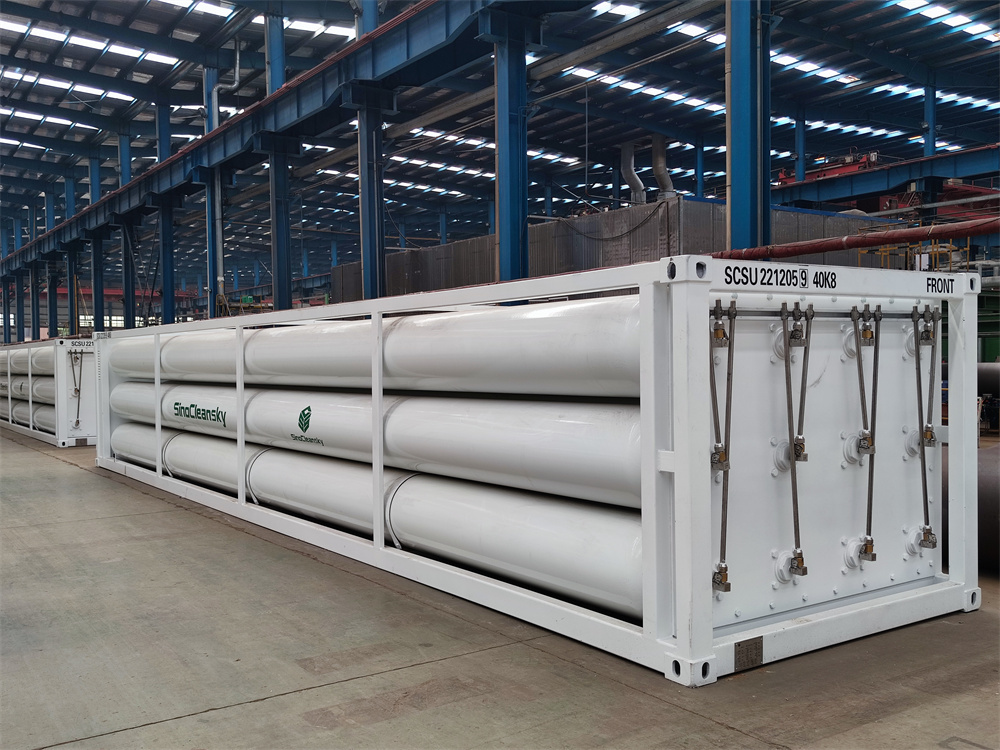
Evaluating CNG Jumbo Tube Containers requires splitting the technical assessment into two distinct components. You must evaluate the high-pressure cylinders holding the gas and the structural ISO frame protecting them. Each component falls under entirely different engineering codes and testing protocols.
High-pressure gas cylinders must comply with applicable international standards to ensure structural strength, pressure resistance, and safe transportation. ISO 11120 covers large seamless steel tubes, while ASME Section VIII applies to pressure vessels within its scope. Manufacturers should verify material traceability, heat treatment records, dimensional accuracy, and pressure testing results. Certification requirements depend on the destination market and equipment classification.
ISO 1496-3 establishes structural and testing requirements for applicable tank containers used in intermodal transportation. The container frame must support lifting, stacking, and transportation loads while protecting high-pressure cylinders. Secure mounting systems and vibration-resistant connections help prevent structural fatigue and piping damage during transportation.
Valves, manifolds, and pressure relief devices are essential for maintaining gas containment safety. Manufacturers should minimize unnecessary connections, verify material compatibility, and test components against applicable pressure ratings. Proper pressure relief device calibration, leak testing, and independent certification help reduce gas leakage and overpressure risks.
Independent third-party inspections help verify manufacturing quality, regulatory compliance, and product conformity before international shipment. Inspection requirements should reflect the applicable standards, destination regulations, and buyer specifications.
Independent inspection organizations, such as Bureau Veritas, SGS, Lloyd's Register, and DNV, can provide relevant inspection, testing, and certification services within their accredited or authorized scopes. Their evaluations may include material verification, welding procedure reviews, manufacturing inspections, and pressure testing to confirm compliance with specified requirements.
Inspection Type | Main Purpose | Key Activities |
|---|---|---|
Type Approval | Verify the container design | Engineering drawings, material specifications, prototype testing |
Initial Inspection | Verify individual manufactured units | Dimensional checks, production records, pressure testing, conformity inspection |
Type approval confirms design conformity, while initial inspection verifies that manufactured equipment meets the applicable approved specifications. Both may be required depending on the governing regulations and certification scheme.
Factory Acceptance Testing (FAT) verifies the structural integrity, pressure resistance, and manufacturing quality of high-pressure gas containers before delivery. Testing may include hydrostatic pressure tests, non-destructive examinations, leak checks, and document reviews. Buyers should verify material test reports, inspection certificates, and applicable test records before issuing final acceptance.
Key Takeaway: Reliable high-pressure gas container procurement requires verified cylinder standards, structurally sound container frames, certified pressure components, and documented third-party inspections. These measures help ensure safe transportation, regulatory compliance, and long-term equipment reliability.
Destination markets dictate the required certification stack. A container fully certified for use in Southeast Asia may be entirely illegal to operate in Europe or North America. Mapping out regional compliance frameworks before issuing a purchase order prevents costly retro-certification efforts and legal battles at the destination port.
Destination Region | Governing Standard | Primary Application | Key Requirement |
|---|---|---|---|
North America | DOT / UN Portable Tank | Road, Rail, Sea Transport | Department of Transportation approval, ASME stamping, NB registration. |
European Union | TPED / ADR | Road Transport of Dangerous Goods | Pi mark certification, strict valve impact protection, notified body approval. |
Global Offshore | DNV 2.7-1 / EN 12079 | Oil & Gas Platforms | Enhanced dynamic lifting standards, specialized pad eyes, MPI on all welds. |
Exporting to the United States or Canada requires strict adherence to Department of Transportation (DOT) regulations and UN portable tank designations. The cylinders must meet DOT specifications, such as DOT 3AAX or DOT UN ISO 11120. The complete container assembly must be registered and approved by the relevant national transport authorities. Failure to secure DOT approval means the container cannot legally travel on public highways, rendering it useless for domestic distribution.
The European market operates under the Transportable Pressure Equipment Directive (TPED) and the ADR (European Agreement concerning the International Carriage of Dangerous Goods by Road). Equipment destined for Europe must carry the Pi mark, signifying compliance with TPED. ADR compliance dictates specific requirements for vehicle roll-over protection, rear impact guards, and emergency shut-off valve locations. A European Notified Body must conduct the conformity assessment.
Eco-friendly supply chains increasingly demand environmental accountability alongside structural safety. There is a growing requirement for Product Carbon Footprint (PCF) Certifications. Buyers must often track Corporate Carbon Accounting and provide Scope 1, 2, and 3 emissions reporting. Manufacturers capable of providing verified PCF data for the steel production and assembly processes offer a significant advantage for buyers facing strict corporate sustainability mandates. Tracking the carbon intensity of the steel smelting process is becoming a standard procurement metric.
If the containers are destined for offshore oil and gas platforms, standard intermodal certifications fall short. Offshore environments require upgraded safety regulations and dynamic lifting standards. Compliance with DNV 2.7-1, EN 12079, and IMO MSC/Circ. 860 is mandatory. These standards dictate heavier frame construction, specialized pad eye designs for crane lifting in rough seas, and enhanced impact resistance to survive collisions on platform decks. Every load-bearing weld requires 100% Magnetic Particle Inspection (MPI) after proof load testing.
Sourcing high-liability equipment from overseas introduces practical implementation risks. Procurement teams must deploy systematic auditing processes to separate capable export manufacturers from domestic-only suppliers. You cannot take marketing brochures at face value.
Baseline quality management begins with verifying active ISO 9001 certification specific to pressure vessel manufacturing. Checking for China's Special Equipment Licensing Office (SELO) certification provides a baseline of domestic competence. However, SELO alone is insufficient for export. Auditors must review the manufacturer's track record of producing equipment specifically to ASME, DOT, or TPED standards. Requesting redacted certificates from past export projects provides tangible proof of capability. Check their welding logs and material quarantine procedures during your factory audit.
Fraudulent or expired documentation is a persistent risk in overseas procurement. Buyers must execute actionable steps for cross-referencing supplier-provided certificates directly with the issuing bodies. If a factory claims Bureau Veritas or DNV Type Approval, take the certificate number and verify it directly through the classification society's official database. Direct communication with the third-party agency confirms the scope of the approval and ensures it covers the exact container model being procured. Never accept a photocopied certificate without independent verification.
Accepting lower bids from manufacturers lacking pre-existing Type Approvals ultimately results in higher overall project expenditure. A factory without existing international approvals must undergo the entire design review and prototype testing phase from scratch. This adds months to the production timeline and incurs substantial engineering fees. Attempting to export non-compliant equipment leads to port rejections and massive retro-certification fees. Prioritizing compliance over initial unit cost is the only viable strategy for high-pressure gas logistics. A cheap container becomes incredibly expensive when it sits impounded at customs for six months.
Define destination-specific regulatory requirements (e.g., DOT, TPED, ASME) in your initial request for quotation to filter out unqualified suppliers immediately.
Request redacted Type Approval certificates and past export documentation from Chinese manufacturers, then independently verify their authenticity through the issuing classification society's database.
Contract an independent third-party inspector, such as DNV or Bureau Veritas, to oversee Factory Acceptance Testing (FAT) and facilitate final Owner Acceptance before the equipment leaves the factory.
Disqualify any supplier who cannot produce verifiable CSC and UIC certifications, as this indicates a fundamental lack of international logistics capability.
A: A certified container typically has a design lifespan of 15 to 20 years, depending on the governing standard and operational conditions. Mandatory periodic inspections, usually required every five years, involve acoustic emission testing and visual inspections to recertify the cylinders for continued use. Failing these periodic tests shortens the operational lifespan.
A: Yes. When contracted for a complete unit inspection, Bureau Veritas validates both components. They verify the structural integrity of the ISO frame according to standards like ISO 1496-3. They also ensure the Type 1 cylinders meet metallurgical and pressure requirements under ISO 11120 or ASME codes, culminating in a unified approval certificate.
A: If a container lacks a valid CSC plate, shipping lines refuse to load it onto the vessel due to safety and liability regulations. Without UIC certification, international rail operators reject the cargo. The shipment gets impounded at the port, incurring severe demurrage fees until you prove compliance or return the unit.
A: Yes. Offshore environments subject containers to extreme dynamic lifting forces and harsh marine conditions. Standards like DNV 2.7-1, EN 12079, and IMO MSC/Circ. 860 mandate thicker structural steel, specialized lifting pad eyes, and rigorous non-destructive testing of all load-bearing welds to prevent catastrophic failure during offshore transfers.
A: Buyers should never rely solely on PDF documents provided by the factory. Take the certificate number and the issuing agency's details and cross-reference them directly through the agency's official online verification database. Alternatively, contact the issuing agency directly to confirm the certificate's validity and scope.
A: ISO 11120 is an international standard focusing on seamless steel tubes for gas transport, widely accepted in Europe and Asia. ASME Boiler and Pressure Vessel Code (Section VIII) is a North American standard requiring specific design calculations, authorized inspections, and a U-stamp. ASME is legally mandated for operation in the US and Canada.
A: Currently, PCF certification is not a strict legal requirement for basic customs clearance in most countries. However, it is rapidly becoming a commercial necessity. Buyers operating under strict corporate sustainability mandates or within European eco-friendly supply chains increasingly require Scope 1-3 emissions data and PCF certification to meet environmental reporting obligations.