
What are LNG exports and why are they reshaping global energy markets? Simply put, LNG exports involve turning natural gas into a liquid form so it can travel long distances safely and efficiently. The U.S. has become a top exporter thanks to shale gas and fracking, supplying countries across Asia, Europe, and Latin America. In this guide, we’ll break down the LNG supply chain, export terminals, transportation methods, and the economic, environmental, and technological factors behind the booming LNG market.
LNG exports start long before it reaches a ship. First, natural gas is extracted from shale, offshore wells, or conventional fields. Then, it travels through pipelines to processing facilities. At these plants, impurities are removed and the gas is cooled into a liquid. Once liquefied, it’s loaded onto specialized tankers for overseas transport. At the destination, LNG is warmed back into its gaseous form for use by homes, industries, and power plants.
Key Steps of the LNG Supply Chain:
| Step | Description |
|---|---|
| Extraction | Gas is pulled from underground reservoirs. |
| Pipeline Transport | Moves gas from wells to liquefaction plants. |
| Liquefaction | Cools gas to -260°F, reducing volume ~600x. |
| Shipping | Transported in LNG carriers across oceans. |
| Regasification | Converted back to gas at import terminals. |
Export terminals act as the bridge between pipelines and the global market. They store and super-chill the gas to -260°F so it can fit in tankers. These terminals are packed with liquefaction trains, massive industrial units that remove heat and compress the gas. They also include storage tanks, loading docks, and monitoring systems.
Terminal Functions Include:
Cooling natural gas into liquid.
Storing LNG safely before shipment.
Loading LNG into specialized vessels.
Maintaining pressure and temperature for safety.
Shipping LNG isn’t like sending oil or coal. It requires massive, insulated carriers built to hold the liquid at extremely low temperatures.
LNG Carriers and Logistics:
Double-hulled tanks prevent leaks.
Cargo tanks are heavily insulated.
Ships travel on fixed routes with strict speed and temperature controls.
Regular inspections ensure safety.
It’s highly energy-intensive, but it allows gas to move thousands of miles efficiently.
Once LNG reaches its destination, it enters an import terminal for regasification. Here, it’s warmed gradually until it returns to a gaseous state. The gas then flows into pipelines to reach cities, power plants, or factories. Some terminals also store LNG temporarily in cryogenic tanks to balance supply and demand.
Heat exchangers raise temperature.
Pressure is adjusted for pipeline distribution.
Continuous monitoring prevents leaks.
Enables smooth integration into local gas networks.
Fracking changed everything for U.S. natural gas. Shale formations, once uneconomical, suddenly produced massive volumes at lower costs. Before fracking, the U.S. imported more gas than it exported. Today, it’s a global supplier.
Shale gas surged production from 8% of total gas to over 30% in just a few years.
Domestic supply expansion made LNG exports feasible.
Fracking lowered costs, boosting competitiveness in global markets.
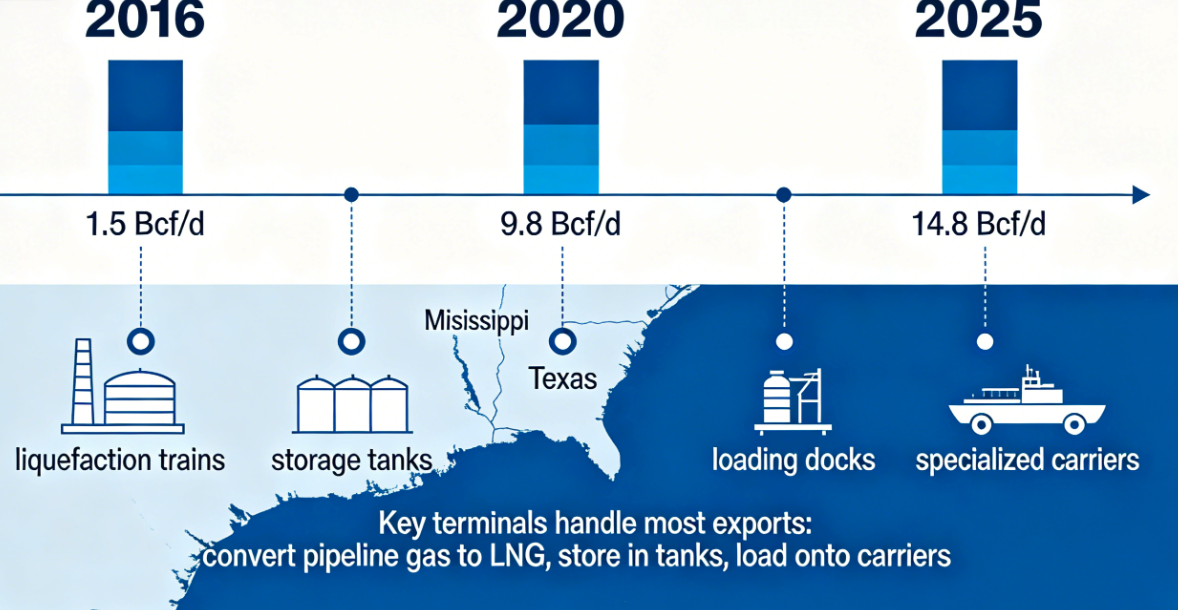
The U.S. first shipped LNG in 2016. Since then, export capacity has grown rapidly.
| Year | Export Capacity (Bcf/d) |
|---|---|
| 2016 | 1.5 |
| 2020 | 9.8 |
| 2025 | 14.8 |
Key terminals along the Gulf Coast handle most exports. These include facilities in Texas, Louisiana, and Mississippi, each with multiple liquefaction trains and storage tanks.
Terminals convert pipeline gas into LNG.
Storage tanks hold it until shipment.
Loading docks fill specialized carriers for international transport.
Pipelines carry gas from fields to export terminals. They form the backbone of LNG logistics. Recent U.S. projects in 2024 added billions of cubic feet underground, easing transport bottlenecks.
They connect shale-rich regions to Gulf Coast terminals.
Reduce dependency on local storage.
Enable smoother, faster LNG export operations.
U.S. LNG now serves countries across the globe. Top importers include Europe, Asia, and Latin America.
Europe relies heavily on U.S. LNG after disruptions in Russian supply.
Asian markets, including Japan, China, and South Korea, consistently purchase LNG.
Latin America imports support growing industrial and power needs.
Geopolitical events, like the Ukraine conflict, spiked demand in Europe, highlighting U.S. strategic energy influence.
LNG provides flexibility when pipeline gas is unavailable.
It allows the U.S. to act as a stabilizing energy supplier internationally.
LNG pricing in the U.S. is much lower than international markets. At around $3 per million British thermal units (mmBtu), U.S. gas is a bargain. Overseas, prices often range $11–18/mmBtu, depending on demand and region. This gap creates strong incentives for exporters. Companies can profit from arbitrage while supplying global markets.
U.S. prices remain stable due to abundant shale gas.
Exporters benefit from higher overseas rates.
Seasonal and geopolitical factors influence international pricing.
Exporting LNG isn’t automatic. The U.S. Department of Energy (DOE) must approve permits for companies shipping gas overseas.
DOE Considerations Include:
Protecting domestic supply and pricing.
Ensuring environmental standards at export terminals.
Reviewing national interest before approving new projects.
These regulations can slow development, but they also provide structure and safety for global trade.
LNG exports fuel the economy in multiple ways.
Job Creation: Construction, operations, and shipping employ thousands.
Revenue: Export sales generate billions annually.
Energy Security: Domestic supply stays robust while meeting global demand.
Communities near terminals and pipeline networks often see local economic boosts.
Building and operating LNG export facilities comes at a high price.
Challenges Include:
Infrastructure costs for terminals, pipelines, and shipping fleets.
Navigating complex regulatory processes.
Maintaining safety and environmental standards.
Construction delays can increase total investment.
Even with strong profits, these hurdles require careful planning and long-term investment.
LNG production and transport consume a lot of energy. Liquefaction, storage, and shipping require electricity and fuel, producing greenhouse gases. Compared to coal, LNG releases fewer emissions when burned, but the overall lifecycle impact—including transport—is still significant. Conventional natural gas pipelines avoid some of these extra emissions, making LNG slightly less climate-friendly than expected.
Liquefaction consumes massive energy.
Long-distance shipping increases emissions.
Lifecycle emissions can rival or exceed coal for some routes.
Fracking powers most U.S. LNG growth. The process injects fluids into shale formations to release gas. Nearby communities often experience higher levels of air pollutants and risks to water quality. Studies show these effects disproportionately affect marginalized groups.
Impacts Include:
Methane leaks and volatile organic compounds (VOCs) in the air.
Contamination risks for groundwater and surface water.
Noise, truck traffic, and industrial activity near residential areas.
LNG is sometimes described as a bridge fuel. It pairs well with renewables because gas plants can run when wind and solar don’t. Policy plays a major role in balancing LNG use and climate targets. Governments consider emissions, local impacts, and renewable energy incentives when approving new export projects.
Considerations for Balance:
Integrate LNG into renewable-heavy grids.
Set strict environmental standards for terminals and pipelines.
Promote methane leak detection and reduction.
Encourage international cooperation on clean energy transitions.
U.S. LNG exports are expected to grow significantly over the next decade. Several new export terminals are already under construction or in planning along the Gulf Coast, and industry forecasts indicate that exports could double within 5–10 years to meet rising global demand. Existing terminals are being expanded and equipped with additional liquefaction trains, while shipping capacity is also increasing to handle larger international flows. These developments position the U.S. to maintain its role as a leading LNG supplier worldwide.
The demand for LNG is expanding beyond traditional buyers, reaching developing countries seeking reliable energy sources for industry and electricity generation. Southeast Asia, including countries like Vietnam and Thailand, is importing more LNG to fuel economic growth. Latin American nations, such as Brazil and Mexico, are also ramping up imports, while Middle Eastern countries are turning to LNG as a cleaner alternative to oil. These emerging markets are reshaping global energy trade patterns and creating new opportunities for U.S. LNG exporters.
Technological advancements are making LNG exports more efficient, cost-effective, and environmentally friendly. Improvements in liquefaction and storage systems reduce energy consumption at terminals, while insulated and lighter LNG carriers allow longer voyages with minimal losses. Automation and remote monitoring help operators enhance safety, prevent leaks, and optimize logistics. Together, these innovations support the expansion of U.S. LNG exports while lowering operational costs and environmental impact.
Government policies play a crucial role in shaping the future of LNG exports. The speed of export approvals, environmental regulations, and broader energy strategies directly affect investment decisions in terminals and shipping infrastructure. Faster permitting processes can accelerate new terminal construction, while stricter emission standards encourage cleaner liquefaction practices. International agreements also influence export targets and market access, ensuring that U.S. LNG remains competitive while complying with global energy and climate policies.
A: LNG export is the process of converting natural gas into liquid form at -260°F for shipment overseas, then regasifying it at the destination for use.
A: LNG is shipped in specialized insulated carriers that maintain super-chilled temperatures, ensuring safe, energy-dense transport over long distances.
A: U.S. prices are ~$3/mmBtu, while international prices reach $11–18/mmBtu, creating strong profit margins for exporters.
A: High lifecycle greenhouse gas emissions, local air and water pollution from fracking, and potential impacts on marginalized communities.
A: Major importers include Japan, South Korea, China, India, Spain, the UK, Netherlands, and France.
As the world relies more on cleaner fuels, LNG exports are becoming central to energy security and global trade. From pipelines and liquefaction to shipping and regasification, every step shapes international energy flows and economic opportunities.
For businesses exploring LNG and natural gas solutions, Beijing SinoCleansky Technologies Corp offers cutting-edge equipment and integrated services. They provide complete CNG, LNG, and NG solutions—products, technology, and support—helping clients optimize operations while staying ahead in the fast-growing gas industry.


