Views: 0 Author: Site Editor Publish Time: 2026-02-11 Origin: Site
Keep an eye on your fuel light—when it turns on, you usually have about 22 miles (35 km) left before you need to refill.
Most CNG vehicles can travel between 180 and 250 miles on a full tank, depending on the vehicle type and tank size.
Monitor your fuel light closely; it usually indicates you have about 20 to 25 miles left before needing a refill.
Choose the right tank size for your driving needs; larger tanks extend your range, while smaller tanks suit short trips.
Driving habits matter; smooth acceleration and steady speeds can significantly improve your CNG mileage.
Regular maintenance, like checking tire pressure and engine tune-ups, keeps your CNG vehicle running efficiently.
Reduce extra weight in your vehicle to enhance fuel efficiency; even small reductions can lead to better mileage.
Weather conditions can affect your CNG range; plan trips according to the forecast to maximize efficiency.
Use online tools and apps to locate CNG refueling stations, especially when planning long trips.
When you ask how long does a full tank of cng last, you need to consider several factors. Most CNG vehicles deliver a range between 180 and 250 miles (290 to 400 km) on a full tank. Standard passenger cars usually reach about 200 miles (320 km) before needing a refill. Compact models often travel around 180 km (112 miles), while larger vehicles or those with high-capacity cylinders can reach up to 250 miles (400 km). Some standard passenger vehicles may only travel around 90 miles on a full tank, especially if the tank is smaller or the vehicle is less efficient.
The actual distance depends on the size of your CNG cylinder and the efficiency of your vehicle. Here is a quick reference for different tank sizes and their typical ranges:
Cylinder Size | Approximate Range (miles) | Approximate Range (km) |
|---|---|---|
60L | 110-130 | 180-210 |
80L | 150-180 | 240-290 |
100L | 190-250 | 300-400 |
You should always check your vehicle’s manual for the most accurate information. Manufacturers design each model with different tank capacities and engine efficiencies, so the answer to how long does a full tank of cng last will vary.
The fuel light in your CNG vehicle acts as an important warning. When it turns on, you usually have about 20 to 25 miles (32 to 40 km) left before the tank runs empty. Many models specifically indicate around 22 miles (35 km) remaining when the warning light appears. This gives you enough time to find a refueling station without risking a complete loss of power.
You should never ignore the fuel light. Running out of CNG can leave you stranded and may damage your vehicle’s fuel system. Always refer to your vehicle’s manual or the label on your CNG cylinder for precise details about the remaining range. The answer to how long does a full tank of cng last depends not only on your driving habits but also on how closely you monitor these indicators.
Tip: Plan your trips with the fuel light in mind, especially if you drive in areas with fewer CNG stations.
By understanding how long does a full tank of cng last and keeping an eye on your fuel gauge, you can drive with confidence and avoid unexpected stops.
Tank size plays a major role in determining your CNG vehicle’s driving range. Larger tanks allow you to travel farther between refueling stops. If you often drive long distances, a 100L tank can extend your range and reduce the frequency of refills. Smaller tanks, such as the 70L, work well for short commutes or city driving. The most common tank sizes you will find are 70L and 100L.
Larger CNG tanks, like the 100L, extend the driving range and reduce the need for frequent refueling, making them ideal for long trips.
Smaller tanks, such as the 70L, are better suited for short commutes and urban driving.
The most common tank sizes available are 70L and 100L.
When you consider how long does a full tank of cng last, always factor in your tank size. Choosing the right tank for your driving needs can help you avoid unnecessary stops and maximize efficiency.
The type of vehicle you drive also affects your CNG range. Different vehicles have unique designs, weights, and tank capacities. These factors influence how efficiently your vehicle uses CNG and how far you can travel on a full tank.
Vehicle Type | Impact on Efficiency and Range |
|---|---|
Sedans | Generally have smaller CNG tanks, leading to reduced range. |
SUVs | Larger tanks but heavier, which can affect overall efficiency. |
Commercial Vehicles | Designed for heavy loads, often optimized for fuel efficiency. |
For example, the Honda Civic Natural Gas claims a range of 220 to 250 miles. In real-world conditions, you might only reach about 130 miles before needing to refill. Always check your vehicle’s specifications and consider your typical driving patterns when estimating your range.
Your driving habits have a direct impact on how far you can go on a full tank of CNG. The way you accelerate, brake, and choose your routes all play a part in fuel efficiency.
City driving usually involves frequent stops, starts, and idling. These actions use more fuel and reduce your overall range. Highway driving, on the other hand, allows you to maintain a steady speed. This helps you get the most out of each tank.
Tip: Plan longer trips on highways when possible to maximize your CNG range.
Driving at high speeds or accelerating quickly can lower your fuel efficiency. Smooth, gradual acceleration and maintaining a moderate speed help you conserve CNG. If you want to stretch your range, avoid rapid starts and heavy acceleration.
By understanding these factors, you can better predict how long does a full tank of cng last and make choices that improve your vehicle’s performance.
You must pay close attention to the load and weight of your CNG vehicle. Carrying extra cargo or passengers increases the overall mass, which directly impacts fuel efficiency and driving range. Heavier vehicles require more energy to move, causing your CNG tank to empty faster. You may notice that your vehicle struggles to maintain optimal performance when loaded beyond its recommended capacity.
Note: Excessive weight not only reduces range but also increases emissions, which can affect both your wallet and the environment.
Consider the following impacts of added weight on CNG vehicles:
Fuel consumption and CO2 emissions rise by 10% when truck weight increases during tasks like trash collection.
CO emissions can jump by up to 30% with additional weight.
A loaded CNG side-loader produces significantly higher emissions compared to an empty truck: 47% more nitrogen oxides (NOx), 31% more carbon monoxide (CO), and 300% more hydrocarbons (HC) during highway driving.
You should avoid carrying unnecessary items in your vehicle. Remove heavy tools, equipment, or cargo that you do not need for your daily routine. If you drive a commercial vehicle, plan your loads carefully to minimize excess weight. This practice helps you maximize your CNG tank range and maintain better fuel efficiency.
You can also check your vehicle’s manual for the recommended weight limits. Manufacturers design CNG vehicles with specific load capacities to ensure safe and efficient operation. Exceeding these limits not only reduces your range but may also cause mechanical issues or safety hazards.
Tip: Regularly inspect your vehicle for hidden weight, such as unused roof racks or storage bins. Keeping your vehicle as light as possible improves both performance and efficiency.
Weather conditions play a significant role in determining how far you can travel on a full tank of CNG. Extreme temperatures, humidity, and wind can all affect your vehicle’s fuel efficiency. Cold weather often reduces the efficiency of CNG engines because the fuel system needs more energy to maintain optimal performance. You may notice that your range drops during winter months, especially if you drive in areas with frequent snow or ice.
Hot weather can also impact your CNG range. High temperatures force your vehicle’s air conditioning system to work harder, which increases fuel consumption. If you drive with the windows open to stay cool, aerodynamic drag rises, causing your engine to use more CNG.
Rain and wind create additional resistance, making your vehicle work harder to maintain speed. Heavy rain can reduce traction, leading to more frequent acceleration and braking. Strong headwinds slow your vehicle down, requiring more energy to overcome the resistance.
You should plan your trips according to the weather forecast. Avoid driving during extreme conditions whenever possible. If you must travel in harsh weather, drive at moderate speeds and use climate control systems efficiently. These strategies help you conserve CNG and extend your driving range.
Callout: Monitoring weather conditions and adjusting your driving habits can make a noticeable difference in how long your CNG tank lasts.
You can extend your CNG tank range by adopting smart driving habits, maintaining your vehicle regularly, and reducing extra weight. These strategies help you get the most out of every fill-up and keep your vehicle running efficiently.
Automotive experts recommend several driving techniques that boost your CNG mileage. You should focus on smooth acceleration and steady speed to conserve fuel.
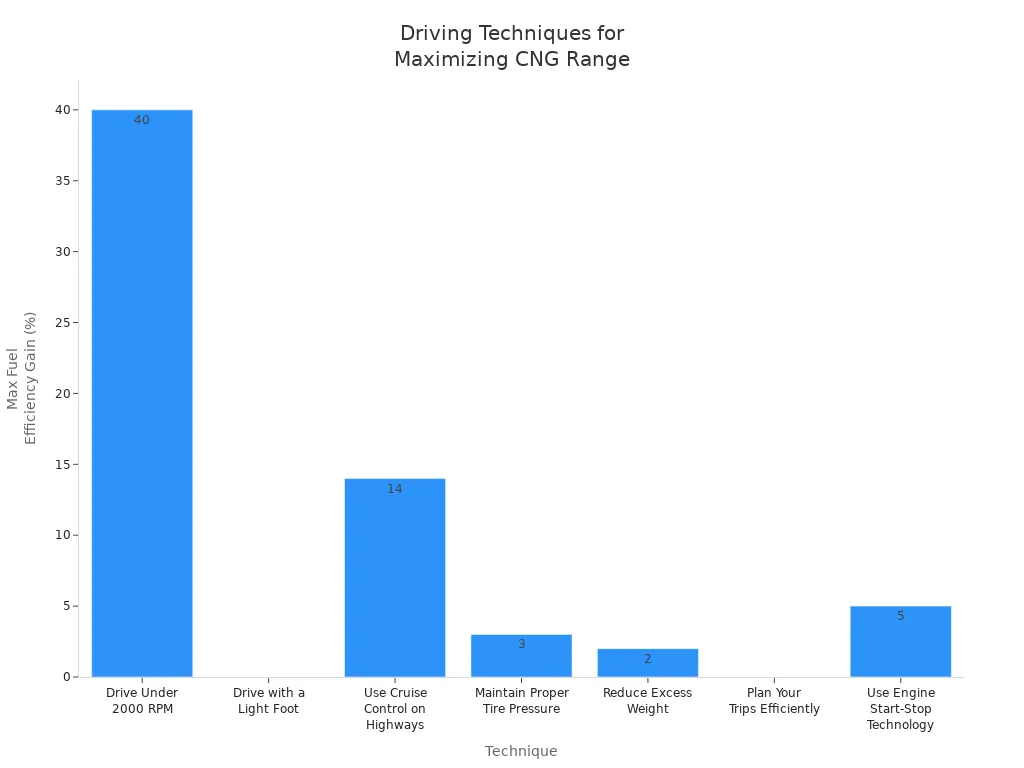
Smooth acceleration reduces fuel waste and keeps your engine running efficiently. You should drive with a light foot, avoiding hard acceleration and sudden braking. Keeping your RPMs under 2000 improves fuel efficiency, especially in stop-and-go traffic. This habit can reduce fuel efficiency loss by up to 40%.
Technique | Description | Benefits/Stats |
|---|---|---|
Drive Under 2000 RPM | Keep RPMs low | 15-30% better efficiency on highways |
Drive with a Light Foot | Smooth habits save fuel | Minimizes waste from hard acceleration |
Tip: Accelerate gently and anticipate stops to avoid unnecessary fuel consumption.
Maintaining a steady speed helps you maximize your CNG range. Using cruise control on highways keeps your speed constant and reduces fuel consumption. This practice can improve mileage by up to 14% on long trips.
Technique | Description | Benefits/Stats |
|---|---|---|
Use Cruise Control | Maintains constant speed | 7-14% better mileage on highways |
Callout: Smart driving habits not only save fuel but also reduce wear on your vehicle.
Routine maintenance keeps your CNG vehicle operating at peak efficiency. You should pay attention to tire pressure and engine tune-ups.
Properly inflated tires reduce rolling resistance and improve fuel economy. Optimizing tire pressure can boost your mileage by up to 3%. You should check your tire pressure monthly and adjust it according to your vehicle’s specifications.
Maintenance Practice | Impact on CNG Mileage and Efficiency |
|---|---|
Optimizing Tire Pressure | Prevents fuel economy loss of up to 3% |
Note: Underinflated tires waste fuel and increase wear.
Regular engine tune-ups ensure your CNG system works efficiently. Testing for CNG leaks and hydro testing of cylinders improves engine performance and gas capacity. These practices prevent gas waste and help you maintain optimal mileage.
Maintenance Practice | Impact on CNG Mileage and Efficiency |
|---|---|
CNG Leakage Testing | Ensures no gas is wasted, improving fuel economy |
Hydro Testing of Cylinders | Enhances engine performance and gas capacity |
Alert: Schedule engine tune-ups and cylinder tests as recommended by your manufacturer.
Removing unnecessary weight from your vehicle increases your CNG range. Lighter vehicles require less fuel to move. A reduction of just 100 pounds can improve mileage by up to 2%. You should clear out heavy items, unused equipment, and roof racks to keep your vehicle as light as possible.
Remove heavy tools and cargo you do not need.
Avoid carrying extra passengers unless necessary.
Plan your loads efficiently if you drive a commercial vehicle.
Callout: Every pound you remove helps your CNG tank last longer and improves overall efficiency.
By following these tips, you can maximize your CNG tank range and enjoy more miles between refills.
You must inspect your CNG tank regularly to ensure safety and reliability. Inspection intervals depend on your vehicle’s weight and usage. For vehicles under 10,000 pounds, you should schedule inspections every three years or every 36,000 miles, whichever comes first. If your vehicle weighs 10,000 pounds or more, inspections are required at least once every twelve months. After any fire or accident, you must inspect the tank regardless of its weight category.
Vehicle GVWR Category | Inspection Interval |
|---|---|
Less than 10,000 lbs | Every 3 years or 36,000 miles, whichever comes first |
10,000 lbs or greater | At least once every 12 months |
After any fire or accident | Must be inspected regardless of GVWR |
Tip: Always follow manufacturer guidelines and local regulations for inspection schedules. Regular inspections help prevent unexpected failures and keep your vehicle safe.
CNG tanks typically last between 15 and 20 years. Several factors influence how long your tank will serve you:
Manufacturing Quality: Tanks built with high standards last longer and perform better.
Material Integrity: Carbon fiber composite tanks resist corrosion more effectively than steel tanks.
Pressure Cycles: The number of times you fill and empty the tank affects its lifespan.
Temperature and Environmental Conditions: Extreme heat or cold can shorten the tank’s life.
Maintenance and Inspection: Consistent care and timely inspections extend the tank’s service years.
CNG Tank Regulations: Compliance with safety standards ensures your tank remains reliable.
Callout: You should never use a tank beyond its certified lifespan. Always check the expiration date stamped on the cylinder.
You need to watch for signs that your CNG system is losing efficiency. Early detection helps you address issues before they become serious.
Monitor your mileage closely. A sudden drop may signal a problem.
Address power loss right away. It could mean a clogged filter or regulator issue.
Listen for unusual sounds when running on CNG.
Check for leaks after every major service or repair.
Schedule specialized diagnostics if you notice performance changes.
Watch for reduced driving range or fuel efficiency.
Hard starting or rough idling may indicate trouble.
Sluggish acceleration or loss of power can point to system faults.
Fuel odor or suspected leaks require immediate attention.
Warning lights or error codes on the dash signal system issues.
Unusual noises or vibrations from the fuel system may reveal hidden problems.
Irregular engine behavior, such as sudden stalls, can indicate container issues.
Alert: If you notice any of these signs, consult a qualified technician. Prompt action keeps your CNG vehicle safe and efficient.
You want to save money on fuel. CNG vehicles offer lower running costs compared to gasoline and diesel models. The price of compressed natural gas remains stable in many regions, while gasoline and diesel prices fluctuate. CNG engines use fuel more efficiently, so you spend less per mile. Many states and cities provide incentives for CNG users, which further reduces your expenses.
Incentive/Program | Description |
|---|---|
Alternative Fuels Tax Credit | 50-cent incentive for CNG, LNG, and liquefied hydrogen used as fuel in motor vehicles. |
Clean School Bus | $5 billion to replace school buses with low-emission models, including natural gas options. |
Clean Fuels Grant Program | Supports clean fuel technologies for transit buses and helps areas achieve air quality goals. |
Tip: You can check local programs and tax credits to maximize your savings when you drive a CNG vehicle.
You care about the environment. CNG vehicles produce fewer emissions than gasoline and diesel vehicles. They emit less greenhouse gases, nitrogen oxides, and particulate matter. This makes CNG a cleaner choice for daily driving. However, CNG vehicles release more methane, which is a potent greenhouse gas. You should weigh this factor when considering your options.
Vehicle Type | GHG Emissions | NOx Emissions | Particulate Matter | Methane Emissions |
|---|---|---|---|---|
CNG | Lower | Lower | Lower | Higher |
Gasoline | Higher | Moderate | Moderate | Lower |
Diesel | Highest | Higher | Higher | Lower |
CNG vehicles show lower greenhouse gas emissions compared to diesel and gasoline vehicles.
CNG vehicles have higher methane emissions, which are significant for global warming.
CNG vehicles produce fewer emissions, making them a cleaner option for users concerned about sustainability.
A recent study found that CNG buses emit much less ammonia than diesel buses. This means CNG vehicles often exceed current emissions standards, especially for ammonia emissions.
Note: Choosing CNG helps you reduce your carbon footprint and supports cleaner air in your community.
You need a reliable vehicle for daily commutes. CNG cars deliver low running costs and high fuel efficiency. You can drive farther on less money, but CNG vehicles have a shorter range than gasoline or diesel models. The energy content of CNG is lower, so you may need to refuel more often.
CNG vehicles are more fuel-efficient than gasoline vehicles.
CNG is less prone to catching fire compared to gasoline and diesel.
If a leak occurs, CNG disperses quickly into the air, reducing fire hazard risks.
You may find fewer CNG refueling stations in rural areas, which can cause inconvenience. Urban areas now offer more CNG stations, making daily use easier. Gasoline and diesel vehicles remain more accessible for long-distance travel because refueling is simpler.
Callout: If you drive mostly in the city, CNG vehicles offer a practical and safe solution for your daily needs.
You can enjoy cleaner air, lower costs, and safer operation when you choose CNG for your daily routine.
You rely on your fuel gauge to avoid running out of CNG. Always check your gauge before starting a trip. The gauge shows how much fuel remains in your tank, but you should not trust it blindly. Temperature changes and driving conditions can affect the reading. If you notice the gauge dropping faster than usual, slow down and plan your next stop. When the fuel light comes on, you usually have about 20 to 25 miles left. Do not push your luck. Refuel as soon as possible to prevent getting stranded.
Tip: Reset your trip meter after every fill-up. This habit helps you track your average range and spot any sudden drops in efficiency.
Locating CNG stations is easier today than ever before. The network of CNG fueling stations keeps expanding, especially in cities. This growth makes daily commuting with a CNG vehicle more practical. In areas with many stations, you can drive with confidence. In regions with fewer stations, you need to plan ahead.
Description | |
|---|---|
Expanding Network | More stations in urban areas make CNG vehicles easier to use for daily commutes. |
Impact on Practicality | A widespread network increases feasibility, while limited stations can make CNG less convenient. |
You can use several reliable methods to find CNG stations:
Use online tools like the Alternative Fueling Station Locator or Google Maps to plan your route and locate stations.
Mobile apps such as AFDC Station Locator, GasBuddy, and PlugShare help you find stations quickly. These apps offer GPS-based searches, user reviews, and real-time updates.
On Google Maps, search for "CNG gas station near me" to get directions, traffic updates, and estimated travel times.
Note: Always check the operating hours and availability of each station before you go. Some stations may close early or have limited service.
Planning a long trip with a CNG vehicle requires extra attention. Experts recommend mapping out your fueling stops before you leave. Contact each station on your route to confirm they are open and have fuel available. This step prevents surprises and saves time.
Plan your route to include multiple CNG stations, even if it means taking a longer path.
Keep a list of backup stations in case your first choice is unavailable.
Learn the fueling process at each station. Some locations may have different procedures or equipment.
Understand potential complications, such as payment methods or station maintenance.
Callout: Careful planning ensures you never run out of fuel on the road. Preparation gives you peace of mind and keeps your trip on track.
By following these strategies, you can make the most of your CNG vehicle, whether you drive in the city or take long journeys.
You now understand how long does a full tank of cng last and what affects your driving range. Monitoring the fuel light and following regular maintenance schedules help you optimize fuel efficiency and keep your engine performing well.
Checking the fuel light prevents unexpected stops.
Routine maintenance protects your engine from wear and inefficiency.
Use these tips to maximize your CNG vehicle’s efficiency. For quick answers, review the FAQ section.
You see the fuel light turn on. Most vehicles display a warning when you have about 20 to 25 miles left. Always check your gauge and plan to refuel soon.
You can drive for a short distance, usually 20 to 25 miles. Refuel as soon as possible. Running out of CNG may damage your vehicle’s fuel system.
You should inspect your tank every three years or every 36,000 miles. If your vehicle weighs over 10,000 pounds, schedule inspections at least once a year.
Tank size, vehicle type, driving habits, load, and weather impact your range. Larger tanks and steady driving help you travel farther.
CNG usually costs less per mile. You save money on fuel and maintenance. Many states offer incentives for CNG vehicles.
You can use online tools, mobile apps, or Google Maps. Search for “CNG gas station near me” to locate the nearest station and check its hours.